01 / NODE
Registry
Product identity, technical attributes, inventory, and media stay coherent as modules are added.
One moment / Route transition
The page is being assembled. Navigation remains available while the content catches up.
Prototype 04 / 3D hardware commerce
An ongoing full-stack prototype connecting a server-rendered storefront, a logic-aware 3D builder, and the operational tools behind the purchase.
Enter the foundry dossier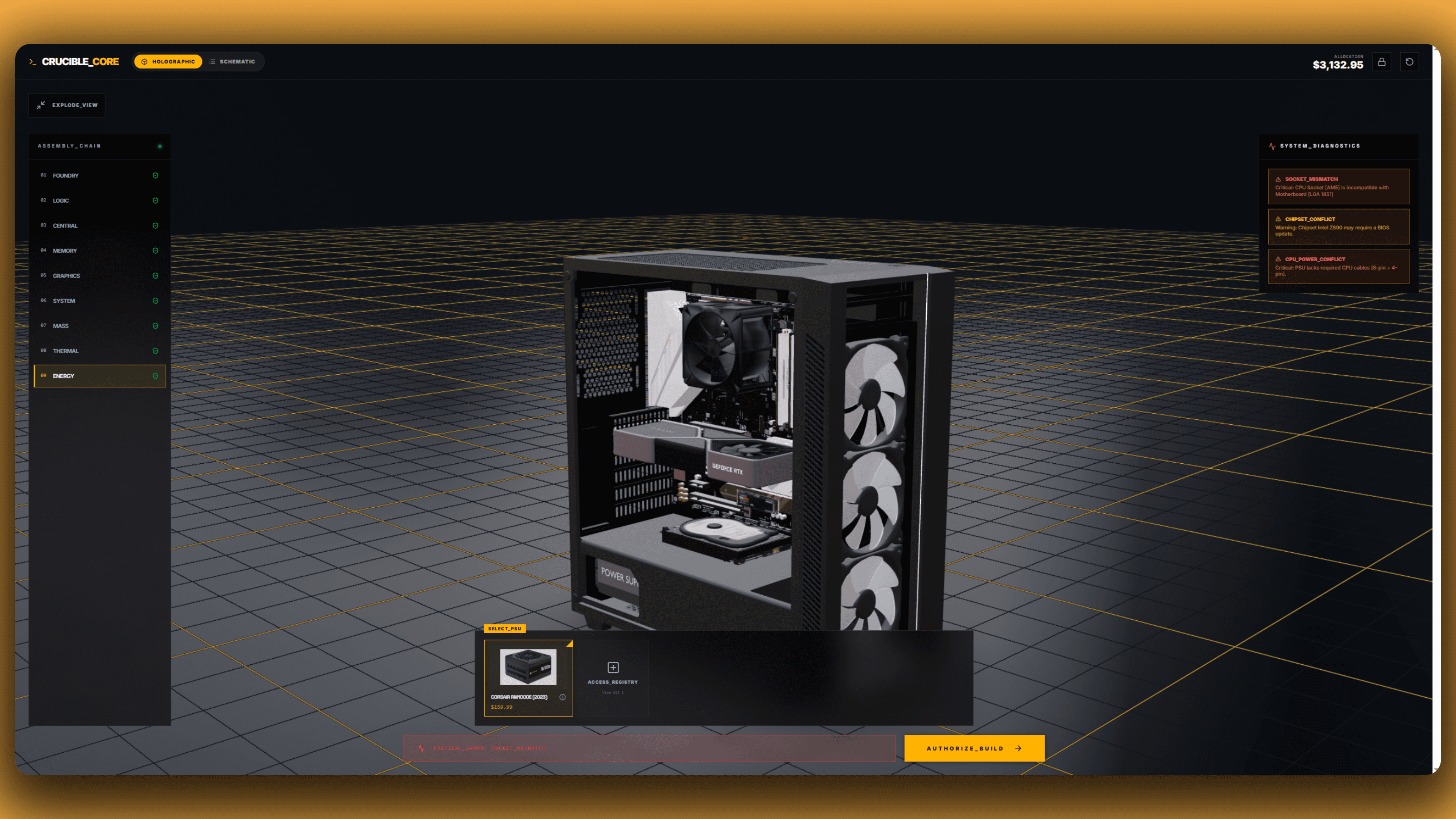
The prototype includes a dedicated 3D configuration interface and visible compatibility feedback.
Current product boundary
BASE 60 is an advanced portfolio prototype, not a production store. The storefront, builder, compatibility logic, data layer, and payment foundations are implemented; production authentication, payment reconciliation, live telemetry, broader automated tests, and a complete accessibility review remain future work.
Ongoing development · not launched
Concept · interface · 3D · commerce · data
PostgreSQL · Prisma · Three.js
Real interfaces · synthetic telemetry
Foundry dossier / The hidden system
01—06
Next: why PC buying is a constraint problem—and how the compatibility resolver keeps domain logic independent from the 3D scene.
02 / The constraint problem
02 / COMPATIBILITY
PC configuration is a chain of physical, electrical, and platform constraints. BASE 60 makes those rules visible before a customer commits to a build.
Resolver contract
The compatibility layer receives a component manifest and returns structured findings. The 3D scene consumes that result; it does not own the rules.
resolveCompatibility(manifest)
A pure resolver keeps domain decisions testable, reusable, and independent from presentation timing.
The buyer's question
The interface answers with a reason, not a mysterious disabled button: socket mismatch, memory generation conflict, insufficient power, or a clearance limit.
The rule surface
6 RULE FAMILIES
Each family maps to a decision the resolver can explain. The list is intentionally concrete: it gives the visual builder an operational vocabulary.
Match CPU and motherboard sockets, then account for chipset and BIOS support.
Keep DDR generation, capacity, and board limits aligned with the selected platform.
Compare system demand with PSU capacity and the connectors the build requires.
Check card length against chassis clearance before a physical fit becomes a return.
Validate cooler height, radiator dimensions, and the case's thermal headroom.
Respect M.2 slots, lane sharing, and the expansion layout of the chosen board.
Architecture / Separation of concerns
ONE SOURCE OF TRUTH
The same result can guide a product card, a builder alert, a cart guard, or an admin review because the rule engine is not coupled to one screen.
Selected parts and their compatibility metadata enter as structured input.
Pure checks compare sockets, dimensions, power, thermals, and expansion.
Zustand carries the build and structured alerts across the experience.
The Crucible renders the current assembly and makes conflicts legible.
The visual layer can animate, explain, and recover from a conflict without silently rewriting the domain decision.
03 / The operations layer
03 / OPERATIONS LAYER
The Overseer gives the product a second audience: the people who maintain the registry, move orders through fulfilment, and watch the signals behind the experience.
Product identity, technical attributes, inventory, and media stay coherent as modules are added.
Order records and fulfilment states become a deliberate operational sequence instead of a hidden backend detail.
Signals make sales velocity and stock saturation visible—without pretending demo values are production analytics.
Module deployment
The ingestion flow treats a hardware module as a system record: its identity, specifications, allocation, and visual assets arrive together.
VISUAL INGEST TERMINAL
Name, SKU, manufacturer, and category establish a stable registry record.
Processor, dimensions, compatibility metadata, and other domain facts stay structured.
Pricing and initial inventory are captured as part of the same deployment flow.
Upload and preview product media before it enters the public catalogue.
The interface and upload flow are portfolio evidence. Cloud delivery, production validation, and permission hardening remain future work.
Order operations
ORDER STATE / 04
The order workspace exposes the handoffs between payment, review, clearance, and fulfilment so the system can be operated—not merely admired.
A new order enters the operational queue with its manifest and customer context.
The team checks the order details and the selected configuration before fulfilment.
A valid order can move forward with an explicit operational status.
The final state closes the loop for the team and the customer.
The interface demonstrates the intended order-management surface. Webhooks, idempotency, fulfilment integrations, and refund handling are not claimed as complete.
Signals / Evidence boundary
The Overseer visual language makes operational signals easy to scan, while the case study stays precise about what the current prototype can prove.
FOUNDRY TELEMETRY
ACTIVE TRANSFERS
008
FOUNDRY HEALTH
99.2%
SIGNAL STRENGTH
99.8 MS
The dashboard composition and visualization direction are real interface evidence. The displayed metrics are seeded demonstration values, not measured adoption, revenue, or live operations results.
05 / What the prototype proves
05 / CURRENT STATE
The prototype demonstrates how storefront, compatibility logic, a 3D builder, cart foundations, and operations can behave as one system—not five disconnected screens.
Current classification
Advanced prototype · ongoing
The decisions that hold it together
DECISION RECORD / 001—003
Three choices keep the foundry concept useful instead of decorative.
Compatibility is modeled as a separate resolver so the 3D scene can explain decisions without becoming the source of truth.
Catalog and commerce foundations stay server-friendly while interactive builder state lives where the feedback needs to be immediate.
The Overseer makes operations visible, but demo records and telemetry are labeled instead of being presented as business results.
The next build
NOT SHIPPED / NEXT BUILD
The roadmap is deliberately practical: harden the boundary between an impressive prototype and a dependable commerce product.
Complete payment webhooks, idempotency, server-side reconciliation, stock safety, refunds, tax, shipping, and transactional email.
Add production authentication, role-aware admin permissions, protected media workflows, and audit trails for sensitive operations.
Replace seeded telemetry with live aggregation, add automated coverage for compatibility and checkout, and optimize 3D loading for constrained devices.
Run a full keyboard, screen-reader, reduced-motion, contrast, and localization review across the storefront, builder, and operations surfaces.
End of dossier / Start of conversation
BASE 60 is a working exploration of how expressive frontend work can carry serious domain logic. The next version is where those foundations become a production system.