Designing a checkout that cannot create ghost orders
How I solved race conditions and 'ghost orders' in Next.js using Stripe Webhooks and Prisma Transactions. A deep dive into building a production-grade checkout system.
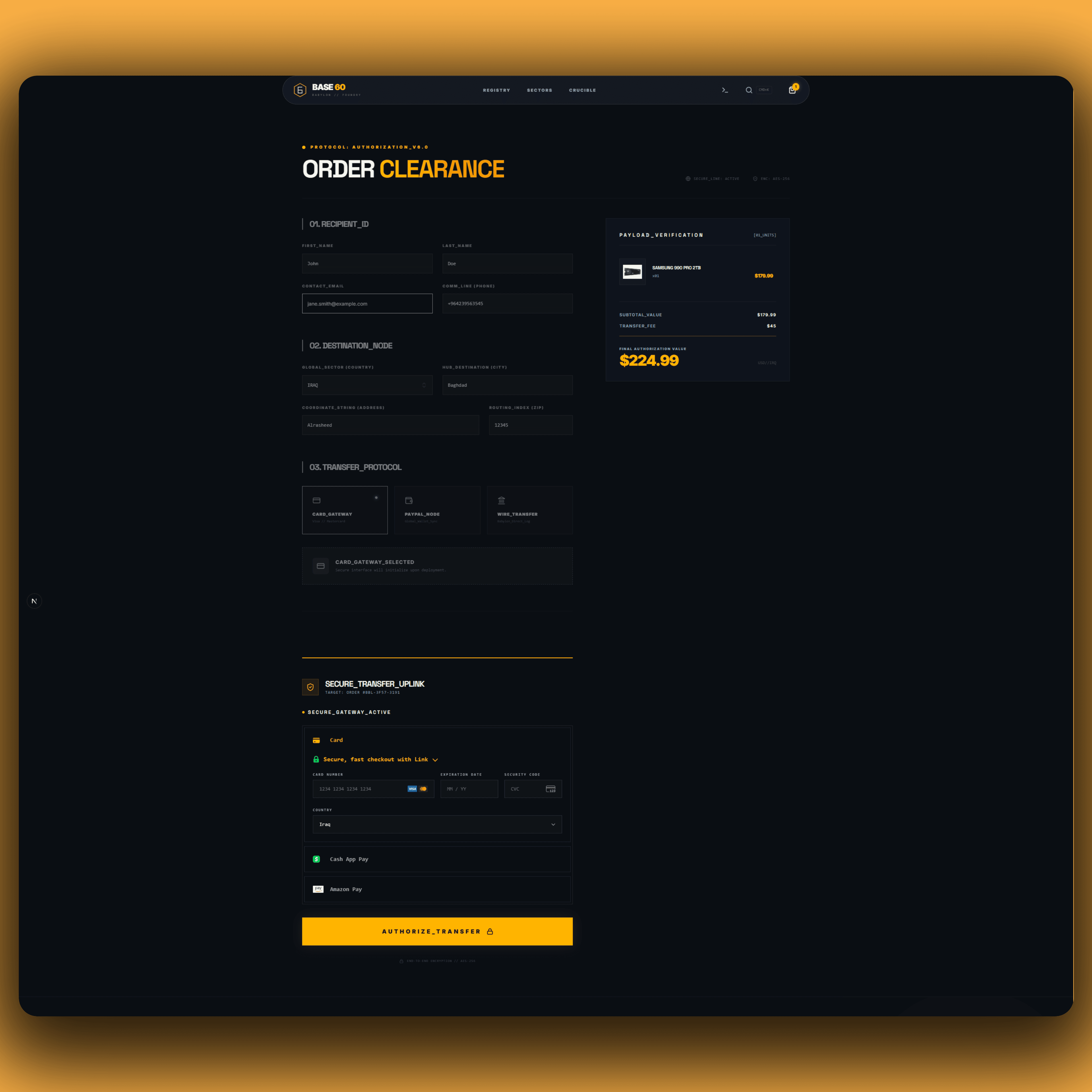
How I solved race conditions and 'ghost orders' in Next.js using Stripe Webhooks and Prisma Transactions. A deep dive into building a production-grade checkout system.
In e-commerce, the "Happy Path" is a myth. Users close tabs mid-payment, internet connections drop, and two people try to buy the last GPU at the exact same millisecond.
If your backend logic isn't bulletproof, you end up with Overselling (selling 11 items when you only have 10) or Ghost Orders (customer charged, but no order created).
For BASE 60, a high-demand hardware foundry, "good enough" wasn't an option. I engineered a Two-Stage Authorization Protocol that ensures absolute data integrity between the User, the Database, and Stripe.
Here is the architectural breakdown of the Secure Handshake.
The Problem: The "Naive" Checkout
Most junior developers build checkout flows like this:
- User clicks "Pay".
- Frontend calls API ->
createOrder. - Frontend calls Stripe ->
confirmPayment. - Frontend calls API ->
clearCart.
This creates critical failure points. If the user closes the window after step 3, the money is gone, but the cart is still full, and the database doesn't know the order is paid.
Phase 1: The Logistics Separation
I split the checkout into two distinct phases to reduce cognitive load and prevent "Junk Intents" in the Stripe dashboard.
- Logistics Entry: The user validates their address and contact info.
- Payment Uplink: Only after logistics are validated do we initialize the Stripe Payment Element.
We use a Next.js Server Action to perform this "Pre-Flight Check":
typescriptSnippet// app/actions/order.ts (Simplified)export const initializePaymentFlow = async (data) => { // 1. Verify Stock (Again) const cart = await getCart(session.id); await verifyInventory(cart); // 2. Create "Draft" Order (Status: PENDING) const order = await prisma.order.create({ data: { ...data, status: "PENDING" }, }); // 3. Create Stripe Intent with Metadata const intent = await stripe.paymentIntents.create({ amount: order.total, metadata: { orderId: order.id, // CRITICAL: The Link back to our DB }, }); return { clientSecret: intent.client_secret };};
By linking the orderId in the Stripe Metadata, we create an unbreakable chain of custody.
Phase 2: The Source of Truth (Webhooks)
The client-side success page is just visual sugar. The Real confirmation happens in the dark, server-to-server.
I built a robust Webhook Handler (api/webhooks/stripe) that listens for the payment_intent.succeeded event. This is the only place where we consider an order complete.
Phase 3: The Atomic Transaction
This is the most technically complex part of the system. When the payment signal arrives, we have to do three things simultaneously:
- Mark Order as
PAID. - Decrement Stock for every item.
- Ensure stock doesn't go below zero (Race Condition protection).
I used Prisma Interactive Transactions to ensure atomicity. If any part of this fails, the entire operation rolls back.
typescriptSnippet// app/api/webhooks/stripe/route.tsawait prisma.$transaction(async (tx) => { // 1. Lock the Order const order = await tx.order.update({ where: { id: orderId }, data: { status: "PAID" }, include: { items: true }, }); // 2. Decrement Stock (The Race Guard) for (const item of order.items) { const product = await tx.product.update({ where: { id: item.productId }, data: { stock: { decrement: item.quantity, }, }, }); // 3. The Fail-Safe if (product.stock < 0) { throw new Error(`Inventory Deficit for ${product.sku}`); // This throws an error, causing the entire Transaction to ROLLBACK. // Stripe will see a 500 error and retry later, // giving the admin time to fix the inventory mismatch. } }});
Phase 4: Price Snapshotting
A common bug in e-commerce is referencing the current product price in order history. If you buy a GPU for 1,200, your order history shouldn't change.
I implemented a priceAt_time field in the OrderItem model.
typescriptSnippet// When moving from Cart -> Orderitems: { create: cart.items.map((item) => ({ productId: item.productId, quantity: item.quantity, priceAt_time: item.product.price, // 🔒 Snapshot value })),},
The Result: Zero Data Drift
By moving the logic from the Client (unreliable) to the Server Actions and Webhooks (reliable), and wrapping the execution in Atomic Transactions, BASE 60 achieves financial grade data integrity.
- No Ghost Orders: Orders only exist if payment exists.
- No Overselling: The database constraint prevents stock form going negative.
- Audit Trail: Every step is logged, tracked, and reversible.
This architecture proves that a seamless frontend experience is only possible with a rigorous backend protocol.